
Police in Ohio cannot automatically search your car simply because they stopped you for speeding, a lane violation, an equipment problem, or another traffic offense. A vehicle search usually requires a separate legal basis, such as voluntary consent, probable cause, a limited search connected to an arrest, or a lawful inventory search.
If you are stopped in Columbus, Ohio, small details can change the legal analysis. Sabol Mallory LLC may review why the stop began, how long it lasted, what officers claimed to see or smell, whether anyone gave consent, and what areas police searched. If the stop led to criminal or OVI charges, those facts may affect whether evidence can be challenged in court.

Dan Sabol
Dan is the first attorney in Ohio to be both board certified in criminal trial law by the National Board of Trial Advocacy and be designated as a Lawyer Scientist by the American Chemical Society.

Chase Mallory
Chase Mallory is a firm founder whom has tried over 40 cases and conducted more than 100 suppression hearings. He is a founding member of the DUI Defense Lawyers Association

Kaitlyn O'Hara
Kaitlyn O’Hara is a criminal defense lawyer who began her work in the court room long before she attended law school. In her first year as an attorney, she was counsel of record on five jury trials.
Meet the lawyers who make up the legal team at Sabol Mallory LLC. Read their individual bios and get to know more about their education, experience and accolades.
Learn more about our teamA Traffic Stop Does Not Automatically Give Police the Right to Search
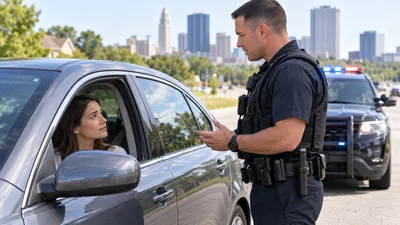
A police officer can generally stop your vehicle when there is a lawful basis to investigate a traffic violation or another suspected offense. During a routine stop, the officer may ask for your driver's license, registration, and proof of insurance, check your driving status or warrants, and handle tasks tied to the reason for the stop.
That authority does not automatically include the right to search your passenger compartment, center console, glove box, bags, or trunk. Police need an independent legal justification before conducting a vehicle search.
Key Point: A lawful traffic stop and a lawful vehicle search are separate Fourth Amendment questions. Police still need consent, probable cause, or another recognized exception before searching your car.
This distinction matters when a routine stop develops into a broader criminal investigation. You can read more about Ohio traffic charges at https://sabolmallory.com/traffic-violation/how-an-attorney-can-help-with-your-ohio-traffic-violation-case/
When Consent Can Make a Vehicle Search Lawful
Consent is one of the most common reasons police search a vehicle without a warrant. An officer may ask whether you will allow a search. If you or another person with authority over the vehicle voluntarily agrees, police may be permitted to search within the scope of that consent.
You do not have to consent merely because an officer asks. If you do not want to give permission, you can calmly state, "I do not consent to a search." Refusing consent does not prevent officers from searching when they have another lawful basis, such as probable cause.
The scope of consent also matters. Permission to look in one part of your vehicle does not always authorize a search of every closed container or compartment. A court may examine the exact words used, whether the consent was voluntary, and whether officers stayed within the permission actually given.
Client
Testimonials
Learn what our clients have to say about the work of Sabol Mallory. If you have any questions or need legal help for a criminal charge, please reach out to us right away.

Chase Mallory is incredible. He is wonderful to work with and knows exactly what to do to help his clients. Thank you from the bottom of my heart for all you've done for me. I highly recommend hiring Chase to help fight your battles. Bless you!
- Erin R.
Dan Sabol is probably the best attorney I've ever worked with. Very professional and worked hard to get the best results possible. He will be the first person I call if I need a lawyer again. If you find yourself in a sticky situation make sure you give him a ring.
- Christopher R.
I had the pleasure of working with Dan and Chase and I am very grateful!! They did amazing work to help me on my case. They are very helpful and get back with you in a timely manner whenever I had questions for them, which was very nice and reassuring.
- Jessica H.
Probable Cause and the Automobile Exception
Police can sometimes search your vehicle without a warrant under the automobile exception. To rely on that exception, officers generally need probable cause to believe the vehicle contains contraband or evidence of a crime.
Probable cause depends on the totality of the circumstances. It requires facts that create a fair probability that evidence will be found, rather than a vague suspicion. Facts that may contribute include contraband in plain view, admissions by an occupant, evidence of unlawful drug use, or other circumstances that suggest the vehicle contains evidence of criminal activity.
The scope of the search is tied to what officers have probable cause to look for. If police have probable cause to search for an item that could fit inside a small container, they may be permitted to inspect places where that item could reasonably be found. If the object could not reasonably be located in a certain area, the justification for searching that area may be different.
If you face charges after a vehicle search, you can also review https://sabolmallory.com/post/choosing-a-criminal-defense-attorney/
Does Marijuana Odor Still Justify a Car Search in Ohio?
Marijuana odor has become a more fact-specific issue since Ohio legalized adult-use marijuana.
Ohio law defines an adult-use consumer as a person who is at least 21 years old. Adult-use consumers may lawfully possess marijuana within statutory limits, but Ohio law restricts how marijuana may be transported in a motor vehicle and does not authorize driving while under the influence.
Ohio Revised Code Section 3796.062 took effect on March 20, 2026. Under that law, previously opened adult-use or medical marijuana generally must be stored in the trunk. If the vehicle does not have a trunk, it generally must be stored behind the last upright seat or in another area that is not normally occupied by the driver or passengers and is not easily accessible to the driver.
Ohio appellate courts have continued to address whether marijuana odor creates probable cause after legalization. In State v. Gray, 2025-Ohio-4607, the First District Court of Appeals held that the smell of marijuana standing alone was no longer enough to establish probable cause to search a vehicle. The court explained that odor can still be considered with other facts under the totality of the circumstances.
In State v. Dejournett, 2026-Ohio-640, the Ninth District reached a different conclusion involving burnt marijuana odor under the law and facts before that court. The decision included a dissent. Because appellate authority can differ by district, the court hearing your case and the facts known to the officer can affect the analysis.
The First District addressed the issue again in State v. Sawyer, 2026-Ohio-2913. The court distinguished Gray because officers had more than marijuana odor. The circumstances included burnt marijuana odor, a burnt marijuana cigarette in an ashtray, the driver's admission of recent marijuana use, and driving the wrong way on a one-way street. The court concluded that the combined facts supported probable cause to search for evidence of unlawful marijuana use and impaired driving.
For a Columbus-area case, a lawyer may examine whether officers reported raw or burnt marijuana odor, whether anyone admitted recent use, whether there were signs of impairment, whether officers saw marijuana or smoking evidence, how marijuana was stored, and whether the search stayed within the scope supported by those facts.
For related information, see https://sabolmallory.com/drug-charges/understanding-drugged-driving-cases-in-ohio/
Can Police Search Your Car After an Arrest?
An arrest does not create unlimited authority to search your vehicle.
Under the Fourth Amendment rule explained in Arizona v. Gant, police may search the passenger compartment incident to an arrest in limited circumstances. A search may be permitted when the arrested person is unsecured and within reaching distance of the passenger compartment at the time of the search. A search may also be permitted when it is reasonable to believe the vehicle contains evidence related to the offense of arrest.
The reason for the arrest matters. An arrest for one offense does not automatically authorize police to search every part of a vehicle for unrelated evidence.
If an OVI arrest is involved, the search issue may overlap with questions about the original stop, field observations, chemical testing, the reason for the arrest, and the officer's basis for extending the investigation.
See https://sabolmallory.com/ovi/top-defenses-against-ovi-charges-in-ohio/
Inventory Searches After a Vehicle Is Impounded
Police may conduct an inventory search after a vehicle is lawfully impounded. An inventory search is treated differently from an evidence search because its purpose is administrative. It may be used to document property, protect belongings, guard against claims involving lost property, and identify dangerous items.
Ohio courts require inventory searches to be conducted in good faith and under reasonable standardized procedures or an established routine. When officers open closed containers during an inventory search, the department generally must have a standardized policy or practice that addresses those containers.
If your vehicle should not have been impounded, or if officers did not follow the applicable inventory procedures, a defense lawyer may examine whether the search can be challenged.
Can Police Use a Drug Dog During a Traffic Stop?
A trained drug dog can sniff the exterior of a vehicle during a lawful traffic stop without automatically making the sniff a Fourth Amendment search. The timing of the sniff is critical.
Under Rodriguez v. United States, police generally cannot prolong a traffic stop beyond the time reasonably required to complete traffic-related tasks solely to wait for a drug dog unless officers develop reasonable suspicion of separate criminal activity.
If a dog arrives while the officer is still completing legitimate traffic tasks, the analysis may be different. If the traffic mission was already completed and the detention continued only so a canine unit could arrive, the added time can become an important suppression issue.
Body-camera video, cruiser video, dispatch records, citation timestamps, computer-aided dispatch records, and the canine unit's arrival time can help establish what happened minute by minute.
What Should You Do If Police Ask to Search Your Car?
A traffic stop can become more serious when it shifts from a traffic matter into a criminal investigation. You can protect your position without arguing with an officer or physically interfering.
Practical steps include:
- Keep your hands visible and follow lawful instructions.
- Provide your driver's license, registration, and insurance information when lawfully requested.
- If an officer asks for consent and you do not want to give permission, clearly state that you do not consent to a search.
- Do not physically block, resist, or interfere with a search.
- Avoid volunteering information that the officer did not request.
- Pay attention to what officers say about the reason for the search.
- Remember whether officers referred to odor, visible items, admissions, a warrant, an arrest, or an inventory search.
- Preserve citations, towing papers, court documents, photographs, videos, and witness information after the stop.
If the stop involved breath or chemical testing, see https://sabolmallory.com/breathalyzer/legal-defenses-against-improper-breathalyzer-test-procedures/
What Happens If the Search Was Unlawful?
When police obtain evidence through a search that may have violated the Fourth Amendment, a defense lawyer can ask the court to suppress that evidence. A motion to suppress may challenge the original stop, the duration of the detention, the voluntariness or scope of consent, the existence of probable cause, the scope of the search, a search incident to arrest, or the way an inventory search was conducted.
If a judge suppresses key evidence, prosecutors may be unable to use that evidence at trial. Suppression does not automatically mean the case will be dismissed. The effect depends on the charges and what other admissible evidence remains.
A careful challenge can depend on records that show what happened before, during, and after the search, including:
- Body-camera footage.
- Cruiser-camera footage.
- Police reports.
- Dispatch and computer-aided dispatch records.
- Citation and stop timestamps.
- Tow records and inventory policies.
- Property sheets.
- Photographs.
- Statements made during the stop.
- Canine deployment and training records when a drug dog was involved.
Preserving these materials can help your lawyer compare the officers' written account with video, timing records, and department procedures.
Speak With a Columbus Criminal Defense Attorney About a Vehicle Search
If a traffic stop in Columbus, Ohio, or a nearby central Ohio community led to a vehicle search and criminal or OVI charges, Sabol Mallory LLC can review the stop, the claimed basis for the search, the evidence seized, and whether a motion to suppress may be appropriate.
The firm handles criminal defense and OVI matters and offers free consultations. Call 614-300-1744 or visit https://sabolmallory.com/contact-sabol-mallory-llc-free-consultation/
This article is for general informational purposes only. It is not legal advice and does not create a lawyer-client relationship. Consult an attorney about the facts of your specific situation.


 |
  |