

Dan Sabol
Dan is the first attorney in Ohio to be both board certified in criminal trial law by the National Board of Trial Advocacy and be designated as a Lawyer Scientist by the American Chemical Society.

Chase Mallory
Chase Mallory is a firm founder whom has tried over 40 cases and conducted more than 100 suppression hearings. He is a founding member of the DUI Defense Lawyers Association
Meet the lawyers who make up the legal team at Sabol Mallory LLC. Read their individual bios and get to know more about their education, experience and accolades.
Learn more about our teamUnderstanding How Weather Impacts OVI Investigations 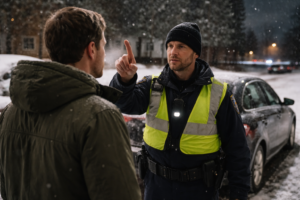
The winter months in Ohio are tough on everyone, but they can be particularly problematic for officers conducting OVI (Operating a Vehicle Impaired) investigations. The weather conditions—often characterized by snow, ice, and sleet—pose numerous challenges for drivers. But the impact of winter on law enforcement is equally significant. From conducting field sobriety tests to interpreting behavior on the road, officers may be more likely to make mistakes during late-winter months, leading to unjust charges and unfair outcomes. Understanding these challenges is crucial for both drivers and defense attorneys.
The Slippery Roads: More Than Just Driver Error
In Ohio, late-winter roads can be icy and unpredictable. When temperatures hover near freezing, roads become slick with ice, and drivers must adjust their behavior to maintain control of their vehicles. Drivers may slow down, swerve, or avoid certain areas—behavior that is often misinterpreted as erratic driving, even though the driver is simply trying to navigate the hazardous conditions. For officers, interpreting this behavior can be difficult. In these conditions, drivers may appear to be impaired even if they are not. An officer might observe swerving, sudden braking, or inconsistent speed—signs commonly associated with drunk driving—but the truth may be that the road itself is to blame. This leads to one of the most common mistakes made during OVI investigations: assuming impairment based on behavior that is actually caused by hazardous driving conditions. When an officer pulls over a driver in these conditions, they might immediately suspect that alcohol or drugs are involved, even when the weather conditions explain the driving patterns. Without properly considering the road conditions, an officer might jump to conclusions, leading to an unnecessary arrest and potentially wrongful charges. That’s why having an experienced attorney, like those at Sabol Mallory LLC, can make all the difference. A skilled defense team can argue that the observed behavior was due to weather, not intoxication.Client
Testimonials
Learn what our clients have to say about the work of Sabol Mallory. If you have any questions or need legal help for a criminal charge, please reach out to us right away.

Chase Mallory is incredible. He is wonderful to work with and knows exactly what to do to help his clients. Thank you from the bottom of my heart for all you've done for me. I highly recommend hiring Chase to help fight your battles. Bless you!
- Erin R.
Dan Sabol is probably the best attorney I've ever worked with. Very professional and worked hard to get the best results possible. He will be the first person I call if I need a lawyer again. If you find yourself in a sticky situation make sure you give him a ring.
- Christopher R.
I had the pleasure of working with Dan and Chase and I am very grateful!! They did amazing work to help me on my case. They are very helpful and get back with you in a timely manner whenever I had questions for them, which was very nice and reassuring.
- Jessica H.
Field Sobriety Tests: Challenging Conditions Lead to Inaccurate Results
Field sobriety tests (FSTs) are crucial tools for officers to determine whether a driver is impaired. However, these tests are designed for ideal conditions—something that is rarely available during late winter months. Snow, ice, and wet pavement make it difficult for drivers to perform tests like the walk-and-turn or one-leg stand. Even without any impairment, a driver’s balance can be significantly affected by slippery conditions, causing them to fail the test. Officers who administer these tests in poor weather conditions may misinterpret the results. For example, if a driver slips while attempting the one-leg stand, an officer might conclude that the driver is too impaired to stand without support, overlooking the fact that the road is frozen. In such cases, the failure of the field sobriety test does not necessarily indicate impairment. Moreover, performing these tests in freezing temperatures presents health risks, including frostbite or hypothermia for both the driver and the officer. In cases where conditions are particularly harsh, officers may even rush through the testing process to complete it quickly, which could lead to procedural mistakes. These kinds of errors can be crucial in a legal defense, and they may form the basis for challenging the accuracy of the charges brought against a client.The Impact of Stress and Time Pressure on Officer Judgment
In the late-winter months, law enforcement officers face added pressure. Not only must they contend with difficult weather conditions, but they are also tasked with ensuring safety in increasingly dangerous circumstances. The time of year can lead to officers feeling rushed, stressed, or distracted. These factors can result in decisions that are less precise than they would be under calmer, warmer conditions. For example, officers might fail to follow protocol in an OVI investigation simply because they are focused on staying warm or completing the stop more quickly due to the harsh conditions. Additionally, officers might overlook key factors that could influence the outcome of the stop, such as considering the weather when interpreting driving behavior or failing to account for the difficulty of performing a field sobriety test. An experienced defense attorney can point to these factors during a trial, helping to demonstrate that an officer’s judgment was impaired by the challenging conditions. This can be especially important in showing that the arrest was based on mistakes rather than actual evidence of impairment. The attorneys at Sabol Mallory LLC are highly experienced in recognizing and using such factors in building a defense against OVI charges.Understanding How Officer Mistakes Affect OVI Cases
When an officer makes a mistake during an OVI investigation—whether it’s due to poor weather, stressful conditions, or rushed decision-making—it can severely affect the outcome of the case. Mistakes can range from improperly conducted field sobriety tests to misinterpretations of driving behavior. Each of these errors undermines the accuracy of the investigation and the fairness of the resulting charges. For example, if an officer fails to follow proper procedures in conducting a breathalyzer test or does not provide clear instructions for field sobriety tests, these procedural errors could be grounds for challenging the evidence in court. Furthermore, if the officer’s decision to arrest was influenced by weather-related factors that were not properly considered, the defense can argue that the arrest was unjustified from the outset. In these cases, having a knowledgeable defense attorney is crucial. The attorneys at Sabol Mallory LLC are familiar with how weather can impact OVI investigations, and they know how to use this knowledge to protect the rights of those accused. A strong defense can often lead to reduced charges or even a dismissal of the case altogether.Defense Strategies for Late-Winter OVI Charges
If you’re facing an OVI charge during the late-winter months, it’s important to work with an attorney who understands how weather conditions can influence both your behavior and the officer’s investigation. Here are some defense strategies that can be employed:- Questioning the Officer’s Observations: If the officer observed driving behavior that was influenced by winter weather conditions, your defense attorney can argue that the officer failed to properly account for these factors. For example, poor road conditions may have caused the swerving or sudden braking, not alcohol or drugs.
- Challenging the Accuracy of Field Sobriety Tests: Field sobriety tests are notoriously difficult to perform, and they become even more challenging when the ground is icy or uneven. Your defense attorney can argue that the tests were compromised due to weather, not impairment.
- Highlighting Officer Mistakes: If the officer made any procedural errors—such as rushing through the investigation, failing to properly administer tests, or neglecting to take weather conditions into account—your attorney can use these mistakes to weaken the prosecution’s case.